
The WisDOT Active Transportation Plan is available now. It’s worth a read. I’ve pulled out a few things to highlight here.
WisDOT envisions that walking, bicycling, and other forms of active transportation will be safe, accessible, and convenient for people of all ages and abilities.
On average, people who walk and bike take more trips to local retailers and spend similar amounts when compared with people who drive. Bicycling contributes greatly to the state’s economy as well; In 2022, the total output of bicycle related industries in Wisconsin was over $5.36 billion.
https://outdoorindustry.org/wp-content/uploads/2017/07/OIA_RecEcoState_WI.pdf
Trips taken alone make up nearly 74 percent of all commute trips in the State of Wisconsin. By investing in active transportation infrastructure, Wisconsin communities can offer viable alternatives to short commute and non-commute trips taken alone. Approximately half of all vehicle trips in the United States could be made by bike in 20 minutes or less, and more than one-quarter of all vehicle trips could be made by foot in 20 minutes or less.
There are many benefits to reducing the number of trips taken alone, including:
– reduced traffic congestion,
– reduced vehicle parking demand, and
– increased lifespan of transportation infrastructure.
Rails-to-Trails Conservancy. Active Transportation Transforms America: the Case for Increased Public Investment in Walking and Biking Connectivity. October 2019.
The majority of motor vehicles produce tailpipe emissions, evaporative emissions (e.g., fuel evaporating in the engine or fuel system), and wear-and-tear emissions (e.g., tire particles, brake dust). These emissions worsen air quality and adversely affect human health. Exposure to traffic-related air pollution has been associated with childhood asthma, respiratory illnesses, and cardiovascular disease, which impacts communities adjacent to high volume highways.
https://www.healtheffects.org/system/files/SR17TrafficReview.pdf
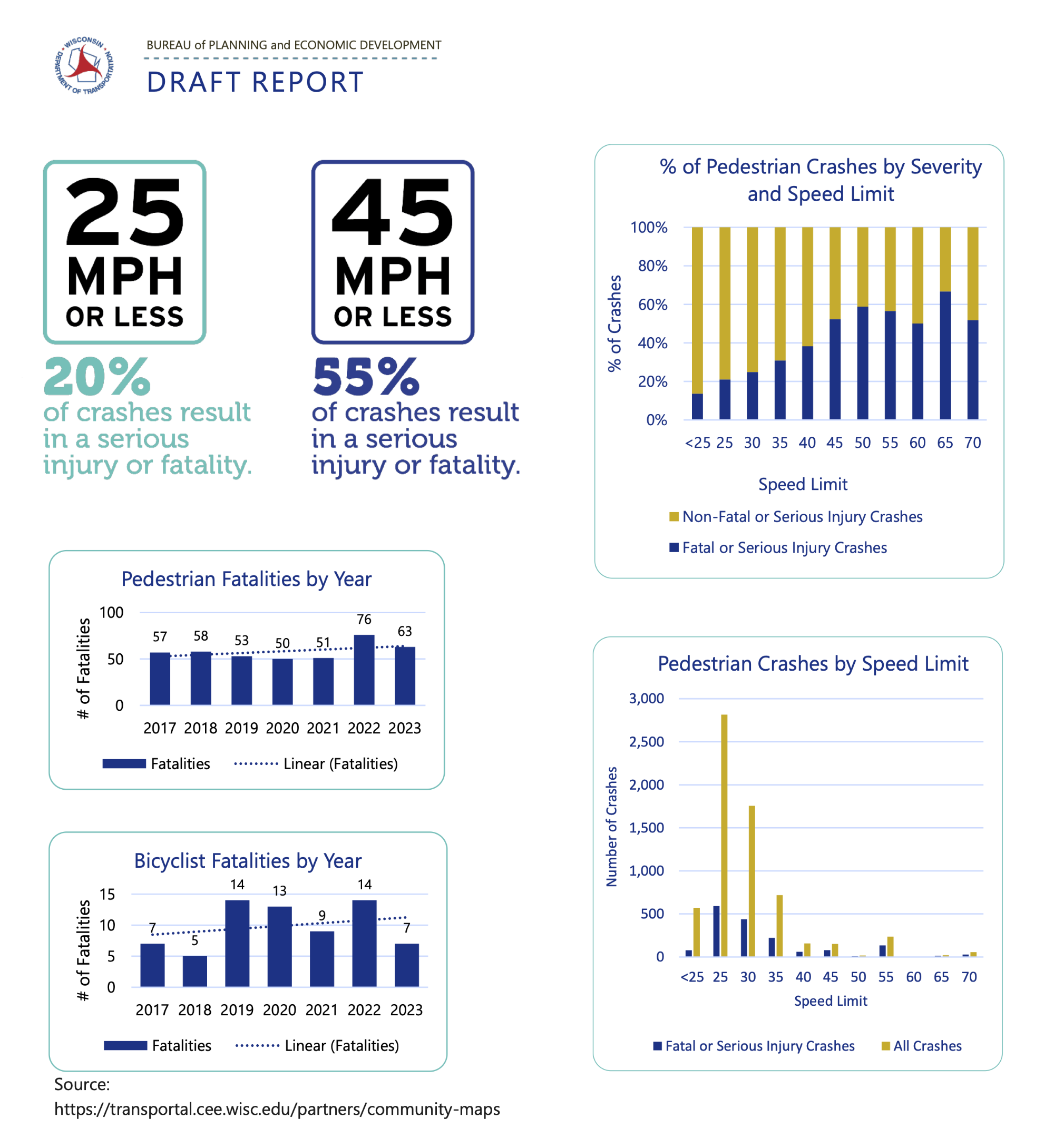
The severity of crashes increases dramatically on roadways with higher posted speed limits, which leads to higher proportions of fatal and serious injury crashes. On roadways with posted speeds of 25 mph or less, 20 percent of crashes result in a serious injury or fatality; on roadways with posted speeds of 45 mph or greater, this rate jumps to 55 percent.
https://wisconsindot.gov/Documents/safety/education/pedestrian/wistudy-pedcount.pdf
Definitions
Active Transportation: Using human-powered means of travel, which includes bicycling and walking, with or without the use of mobility aids, and may also include using other human-scaled or micromobility devices that may be electric-powered or electric-assisted, such as e-bikes and e-scooters.
Complete Streets: Streets that are designed to provide safe and convenient travel for all users, including pedestrians, bicyclists, riders and drivers of public transportation, as well as drivers of other motor vehicles, and people of all ages and abilities, including children, older adults, and individuals with disabilities.
Rolling: Rolling is an inclusive term that refers to people using other wheeled mobility devices such as wheelchairs, scooters, skateboards, and other mobility aids. Typically used with the phrase ‘walking, biking, and rolling,’ and included in active transportation.
Separated Facilities: A shared use path, side path, or sidewalk that is physically separated with a vertical barrier from motor vehicle traffic.
Shared Use Path: Shared use paths, also commonly referred to as trails or greenways, are paths designed for and generally used by bicyclists, pedestrians, and other non-motorized users. A side path is a type of shared use path that follows the alignment of the roadway.
Vulnerable (Road Users and/or Modes): Non-motorists including pedestrians, bicyclists, other cyclists, and persons on personal conveyances.
I may add more things here after another read through. I occasionally spend time tying to education people about things like how Cars Ruin Cities but most car-brained people tend to think that there is a War on Cars and every bike lane and cyclist is a threat to their way of life.
(Local copy in case the original moves or disappears. WisDOT-ATP-Draft)