Categories
Uncategorized

Fight COVID-19 with 3D Printing

I was talking to Caleb the other day and I mentioned how my favorite thing happening was the pairing of 3D printing nerds and people sewing masks collaborating because the sewers want bias tape makers and you can easily make them on a 3D printer. I swear I heard someone I know cry out “Finally! Having six different 3D printers will pay off!”

But seriously, Caleb wrote it up for MAKE, 3D Print This Simple Tool Now, To Help Local Sewers Make More Masks for Covid-19, and yes, it is a useful tool. I’ve probably given away over 50 of them in the last week.

Like others, I had started by printing visors for face shields, but I then jumped into the efforts we’re spearheading at Milwaukee Makerspace to produce a high volume of visors by milling HDPE on CNC machines. It’s faster, and the material choice is perfect for cleaning, disinfecting, and reuse, which may not be the case for 3D printed visors. (But, hey, if a 3D printer is all you’ve got, print away!)

So what is “bias tape” anyway? I will admit, I am not much of a maker when it comes to sewing, but these photos from a friend help illustrate how you use this thing. It’s for making the straps of a face mask that has ties on it. I guess elastic is running out, and some hospitals don’t want elastic, so you make your own bias tape with this thing.

Cut your fabric to size, pin it to your ironing board, run it through the device, and iron it down… then you sew it. (I think I got that right.) Also note, I did not design this. Someone mentioned they were printing this 4cm model so I just offered to help by printing more. I then cajoled a few local friends with 3D printers to also start printing them… we’ve made a lot of them now.

Last week when I was printing them like mad I was doing one at a time so I could grab it off the print bed, toss it in the box on my front porch and always have the box well stocked, as people were coming all day long to get them. Typically you might fill your print bed with 9 or 12 or 16 and hit print and come back 12 hours later, but I wanted these out fast, when there was demand, so one at a time made sense. (Plus, I’m working from home and a break every 35 minutes to walk to the printer helped me get my steps in!) I asked a friend to print some and he said “Yeah, I’ll have a bunch in 6 hours” but we had people wanting to pick one up ASAP, so…

While the full bed does make sense for overnight or if you’re away from the printer, I eventually switched to “one at a time sequence printing” where my printer will print 4, but not all at once, it will print one, then move to an empty part of the bed, print another, etc. This allows me to grab one off the bed as soon as it’s done, and the printer keeps going without me having to hit print again. This is great because even though I monitor the printer, I might be on a long call or doing something else where printing one at a time isn’t ideal.

The two groups I’ve been giving these to are The Masked Sewists for SE Wisconsin and Wisconsin Face Mask Warriors. Let me tell you, these sewing people have quite the maker network happening! They’ve got drop off points, tips & tricks for making, and they are sharing and encouraging each other. My favorite post was one that said “Finally! I can use all the fabric I bought for imaginary projects.” I think many makers can identify with that statement.

The other things I printed last week were these PAPR connector parts. I got a message last week from a guy who said they were working on this Open Source PAPR (Powered Air-Purifying Respirator) project, and wanted prints to make molds for resin casting the parts. I printed four sets so he could send them out to four teams to work on. I haven’t heard back on their progress yet but I wish them well.

Oh, one last story! I got a message on Facebook from a lady who wanted one of the bias tape makers and I said “Come get one! They are on my porch!” and she said “I’m in Florida, can you ship one?” So I asked where in Florida, and she said Orlando… so I got her in touch with my pals at MakerFX and they printed one for her. Maker Network Activated!

Categories
Uncategorized

Hangers

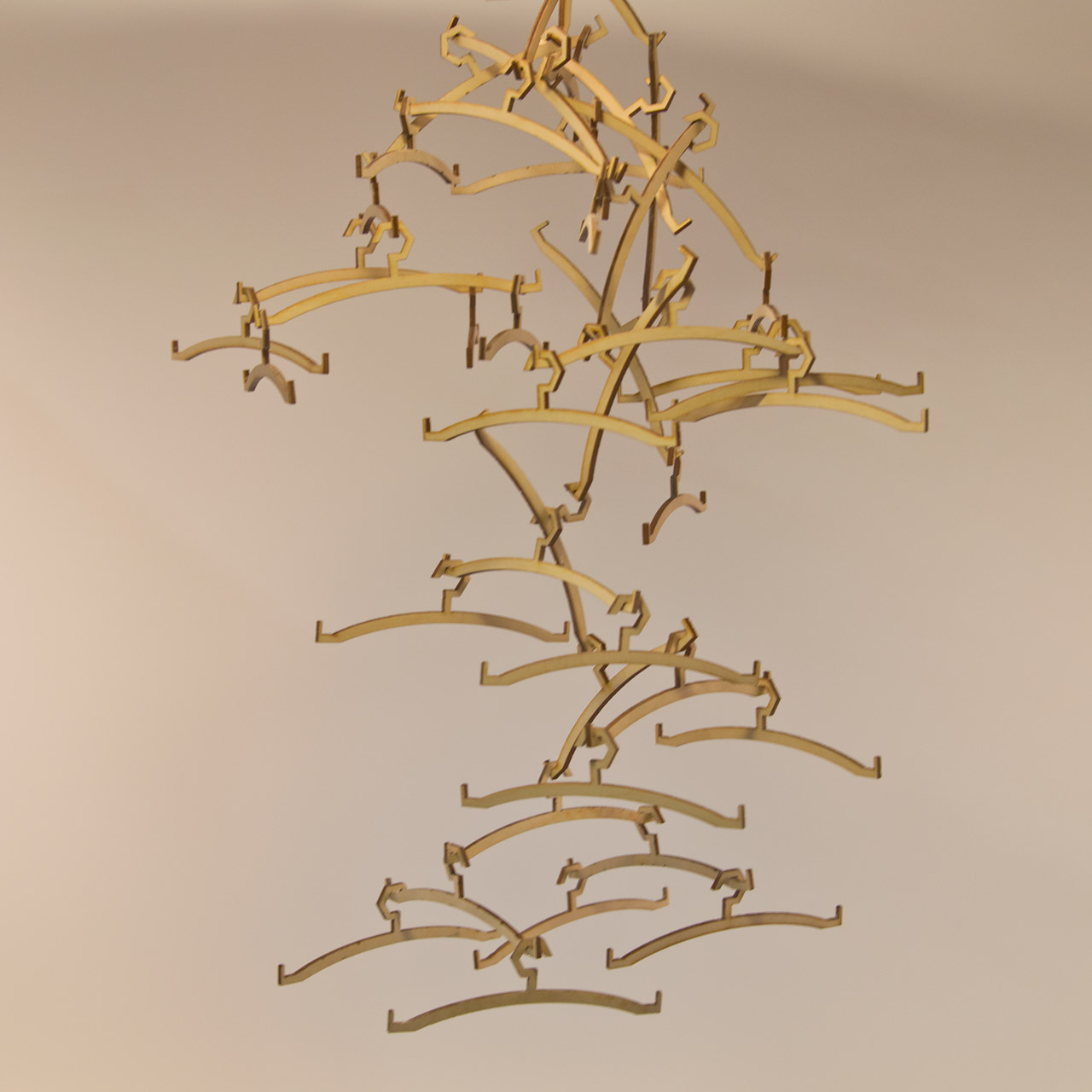
Back in 2018 while at Brinn Labs I was tasked with doing a mobile activity (the kind of mobiles you hang, not the kind that are British cell phones) and I came up with an idea based on the work of Man Ray, specifically his Obstruction sculpture.

man-ray-obstruction-instructions

hanger-svg

I designed a hanger that could be fabricated at a small size (approximately 5″ x 1.5″) and could hang more hangers from the ends. Man Ray’s version used full size hangers that had wire hooks and holes on each end of the wooden part which made it easy to link them all together. Mine was a bit different with a simpler one-piece design. I assume the hangers Man Ray used could swivel completely around, which is an added bonus my version would not have. (But there’s always more than one way to do it.)

Here’s a hanger laser cut from 3mm Baltic Birch plywood. The nice thing about 3mm Baltic Birch plywood is that it’s easy (for me) to find scrap that is around 1.5″ tall and use it for this, which meant I had no real material cost as I could essentially create these from scrap.

I should note that I originally tried using corrugated cardboard, which is even more abundant than 3mm Baltic Birch plywood. While it sort of worked, it depended a lot on exactly where the corrugation was after cutting. I abandoned the cardboard version after a few tests. (If I had made larger hangers I think the cardboard version could have worked fine.)

Because the hanger was a simple 2.5D object I also created a 3D printed version of the hanger… like many of the things I create I tend to come up with ways others could make them depending on the equipment they have available. If you don’t have a laser cutter but do have a 3D printer you can still easily create a bunch of these.

In the photo above you see four versions. Version 1 is the plain Baltic Birch version; Version 2 is a sanded and stained Baltic Birch version; Version 3 is a 3D printed version using grey PLA plastic; and Version 4 is laser cut from clear 3mm Acrylic. Again, multiple methods and materials to choose from.

Since I was working towards making a lot of hangers for an event I just cut them all quickly on the laser cutter and didn’t pay much attention to quality, so the backs of the wood hangers got a bit charred from the honeycomb bed. This is the part where it shouldn’t matter, but sometimes things bug you… so later I ended up designing a small jig to hold the hangers so I could sand them and make them look nice. I don’t know why I torture myself… I hate sanding.

Designing the jig involved creating a slightly larger version of the hanger and then differencing it from a small rectangular shape, then 3D printing it. It worked well to hold the hangers in place while sanding them, but in the end staining them a darker color was much easier. (Again, I really hate sanding.)

When I made the hangers I sort of envisioned it as a game where one or more people would try to build the hanging structure without it falling. Sort of a reverse Jenga perhaps, or maybe more like Barrel of Monkeys though I’ll admit I was completely wrong about how you play Barrel of Monkeys, and this video shows the correct way.

Overall I’m fairly pleased with how this projected turned out. Oh, I should note that the hexagonal tops on the hangers were mean to mimic the hexagonal logo of Brinn Labs. they could certainly have been more rounded or another sort of shape. Who knows? I may redesign these hangers in the future after a bit more prototyping. As I mentioned, this was a quick project and once I got a working hanger I just kicked out a bunch.

hanger-square8877

I hope I was able to create the “increasing confusion” that May Ray talked about in the instructions for Obstruction. It’s certainly a bit confusing when you are creating the structure, and at times I wished I had a helper to attach two hangers while I was attaching two hangers.

I’ll probably get around to releasing the files for this in case anyone else wants to do something with it.

Categories
Uncategorized

Dodecahedrons

dodecahedron-connectors

I honestly can’t remember where I got the idea to make a bunch of dodecahedrons for Maker Faire Milwaukee came from, but I do remember looking at Thingiverse for some connectors I could use with 1/4″ dowel rods. I know I tried Trammell Hudson’s design, since I always admire his work, but I was not using pencils, so it didn’t work. I did attempt to alter his file, but ultimately ended up designing my own file, which worked well enough that I wanted to share it. (Check out Dodecahedron Connector on PrusaPrinters.)

dodecahedrons-colors-01

So I made nine dodecahedrons that could hang from the ceiling in the Dark Room. And since they’d be in the Dark Room I figured I should use fluorescent filament to create the connectors, and fluorescent paint to paint the wooden dowel rods, and with help from Kathy H. at Milwaukee Makerspace, we got everything painted. Sadly, we did not get the blacklights set up in the Dark Room due to budget constraints, and there was too much light where they were placed, and we had to bundle them all together, and… well, anyway, they turned out great, despite a few issues with presentation.

dodecahedrons-small-01

I’ve also made a smaller (hand-held) model for home. It’s small enough to fit on a 13″ MacBook Pro, though I might hang this one from the ceiling as well. Or maybe make it into a lampshade. I don’t know yet.

dodecahedrons-mms-01

This is the original version, which uses 12″ long, 1/4″ diameter wooden dowel rods. A pack of 100 dowel rods is under $15, and a roll of fluorescent filament is about $22. Since you need 30 dowel rods and 20 connectors per dodecahedron you can easily build three large ones (or a lot of small ones) for under $40 USD as long as you’ve got access to a 3D printer.

Did I mention I really like dodecahedrons?

Categories
Uncategorized

Return of the RED Matte Box Rail Mount

red-matte-box-rail-mount-stl

NOTE: Want to purchase one?
See our shop for a RED Matte Box Rail Mount

Many years ago (approximately five) I was using a RED ONE Digital Cinema Camera at my job, and I’d often use digital fabrication to create camera accessories and parts. One of the parts I made was my own version of a RED Matte Box Rail Mount.

I guess I never got around to uploading the file to Thingiverse or Youmagine, but I did have a blog post online since 2014, so I guess it shouldn’t have been too surprising when someone emailed me asking if I could sell them one. Since I 3D print things all the time, I let them know I could certainly print one and send it off to them, which I did.

red-matte-box-rail-mount

I’m glad Sarah is enjoying a cost effective way of holding her matte box in place. If you need something designed and created, let me know… I might have already done it and have the model sitting around waiting to be fabricated again.

Categories
Uncategorized

Designing an Omni Wheel

omni-wheel-01

I was at a robotics event a while back and saw so many omni wheels I got inspired to try to design one. I remember looking up omni wheels years ago and seeing how expensive they were, so 3D printing my own seemed like an obvious choice.

omni-wheel-model-01

I mostly succeeded in designing and making one, but it’s also quite a bit of a failure. Don’t get me wrong, it was a fun exercise, and I tend to enjoy a design challenge, but these aren’t gonna work.

omni-wheel-03

I had planned on brushing Plasti Dip onto the wheels to give them some grip, or maybe casting them from Silicone. (Someone else suggested printing with TPU filament.) If I get back to this project I might consider some of those ideas…

omni-wheel-model-02

So where was my big mistake? When I modeled this, I did not model in the hardware. Sure, I modeled in the holes for the hardware, and what I thought was enough space for the heads of the bolts, but the bolts stick out just a bit too much. As I said, this was a fun exercise, and maybe I’ll revisit it in the future but…

omni-wheel-02

I went looking for omni wheels again and found this VEX IQ 63mm Omni Wheels (2pk) for about $10, which means for $20 I got 4 really nice omni wheels. They might also serve as a reference if I try redesigning my wheels, now that I have a good example to go from. Maybe my choice of 3mm hardware was a poor one. Hmmm, I’m already thinking about the next iteration.