Categories
Uncategorized

Arcade Button Wrenches

I use a lot of these Big Dome Pushbuttons in my line of work… and I also use the GoldLeaf Pushbuttons and sometimes you just want those things screwed in tight. So I made wrenches for both of them so you can screw them in tight.

You can get the STL and .scad files from Printables.com – Big Dome Pushbutton Wrench and also from Printables.com – GoldLeaf Pushbutton Wrench

One more word of advice, at least for the Big Dome, though it’s not a bad idea for the GoldLeafs as well… Once everything works and you’ve tightened the nut in place, add hot glue. Add a lot. Hot glue the shit out of that nut. Glue it to the panel it goes through, and glue it to the threads of the plastic housing. Why? Because I’ve seem both kids and adults in my time twist the button until it rips the wires off. It’s possible with the Big Dome if not glued down, and while I’ve never seen it on the GoldLeaf buttons, I still add glue just in case.

Oh, this is also the first time I’ve tried PolyMaker filament. I grabbed a roll of Polymaker PolyTerra “Army Light Green (HEX Code – ?A78403)” Matte PLA Filament. I like the color, but I realized this may be the first time I’ve used matte filament. It’s different than what I’m used to, but I don’t hate it. The PolyTerra PLA comes on cardboard spools, which should be more environmentally friendly than all those darn plastic spools. Supposedly for every Polymaker PolyTerra spool sold a tree is planted. I don’t know how to confirm that but if true, that’s a nice thing.


Note: This post contains an Affiliate Link. Read More.

Categories
Uncategorized

Your Recipe is Killing Me…

I like to bake and make in the kitchen and while I have my own recipe collection I still look up recipes online all the time, which I think is a common thing to do. There are a lot of “food bloggers” or recipe sites and the old joke is that you have to read someone’s life story before you can read the recipe. “I’m a busy mom with three active kids and a husband who works a lot of hours” or however it goes before a long story about how a quick and easy recipe is just the ticket for a weeknight with soccer practice and swim lessons…

Where was I? Oh yes, I’m a busy maker who just wants the damn recipe. I often use an old iPad in the kitchen and I’ve noticed that some of these food/recipe blogs are so overrun with ads… popup ads, video ads, and lots of faff, that my iPad sometimes can’t even render or properly load the page.

Now I know these bloggers are trying to make a living (or at least extra money) by “posting content” that will get clicks and views and all that but I hate it. I hate it. So I will visit your site one time, I will copy and paste your recipe into my digital notebook and use that, and add my own notes, and keep the URL in case I ever want to visit again, and if I make changes I may even share it on my own blog.

You can find all of the recipes I’ve shared (free of ads and tracking) by following the recipe tag.

(And yes, I do know about ad blockers, I run uBlock Origin on my desktop browsers, etc. I should probably just stick to using the laptop in the kitchen to keep things clean.)

Update: Check out cooked.wiki!

Categories
Uncategorized

Customizable Trays in OpenSCAD

A 3d Printed Customizable Tray

This is an OpenSCAD script that can create custom trays/drawers based on the dimensions you set, because it is a parametric design. If you’re new to OpenSCAD this might be a nice project to examine. It uses the BOSL2 library (Belfry OpenSCAD Library, v2.0), and it’s a pretty simple and (hopefully) easy to understand script.

A 3d Printed Customizable Tray

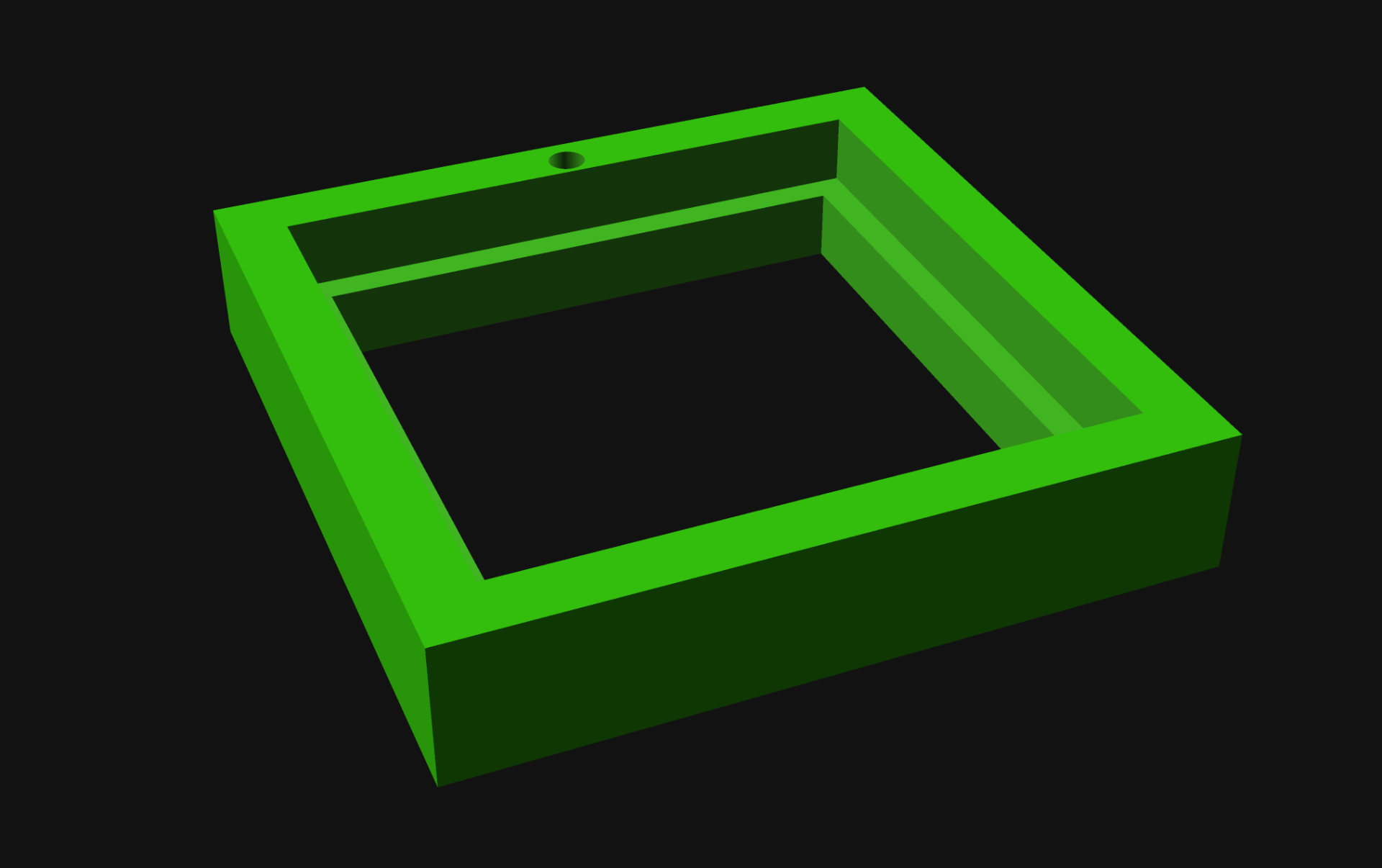
I tend to use this to create small “drawers” to fit on my desk, or under my monitor stands. The large one pictured is 185x185x40, but the idea is for you to make them whatever size you need as it’s a parametric design where you set the variables to have whatever values work for your specific situation.

A 3d Printed Customizable Tray

If you’ve used OpenSCAD and mainly stuck to the cube you might want to look at the MCAD library or the BOSL2 library, as they offer a lot more options for creating cubes (and other shapes). Of course with more power comes more complexity, but you can make rounded cubes of all sorts with MCAD and BOSL2. (MCAD was my go-to for rounded cubes but I’m just getting into BOSL2 and this is my first project using it.)

You can get the .scad file from Printables.com – Customizable Tray. Open the .scad file in OpenSCAD, change the dimensions, and render a tray!

A 3d Printed Customizable Tray

Categories
Uncategorized

Rugged Parametric Box in OpenSCAD

Universal Parametric Rugged Box by Rainer Backes is perfect. Read more below if you need to.

Universal Parametric Rugged Box by Rainer Backes

I mentioned “Rugged Boxes” a bit in my Hardware Gridbox post, but the idea is basically a small box with a latch that is rugged, so it’s like a tiny Pelican case that you can print yourself.

It’s the sort of thing that if you want one a specific size for a specific use that someone else also needs, you might find it easily… but if you want it a custom size just for your specific application, well… you need to be able to adjust the design. There are a bunch of parametric designs that work with Fusion 360 (which I do not use) and I don’t know if Rugged Box (Parametric) by Whity is the original but it’s definitely quite popular.

Here’s an 80x80x60 version I printed, but I wanted something smaller. I tried this one but didn’t like it. So finally, we’ve got one that ticks all the boxes!

Universal Parametric Rugged Box by Rainer Backes is perfect. And by “perfect” I mean it’s written in OpenSCAD, and it works. At least my first print worked, as you can see by the photos. I haven’t pushed the design too hard yet, but being done in OpenSCAD means I can go crazy with it.

This saves me the trouble of having to write my own, which I did start working on. While I do enjoy designing objects I also enjoy finding code that someone else wrote that does exactly what I need. It looks like Rainer has a bunch of models written in OpenSCAD, so I may need to dig through the others for inspiration. Thanks, Rainer Backes!

Categories
Uncategorized

xtouch Controller for P1S

As I mentioned in my post about the Bambu Lab P1S the control panel leaves a lot to be desired… I also mentioned I might try the xtouch controller, and I did, and it works great.

You can grab the code from the xtouch GitHub repo and if you’re lucky like I was it’ll just freaking work on the first attempt. I say this only because I joined a Facebook group for the xtouch and like all Facebook groups there seem to be a number of people who just cannot get things to work. I was pleasantly surprised at how easy it was to set up.

By the way, these “Cheap Yellow Displays” were recently covered on Hackaday in the post “Cheap Yellow Display” Builds Community Through Hardware which is worth a look if you have other ideas.

I printed this Bambu Lab P1P/P1S/X1C Touch Screen Desk Stand (xTouch) and I have it sitting on my desk for now as a remote monitor. I’m not even sure I will attach it to the printer as most people seem to do.

My only gripe is that it doesn’t do more, but it sounds like that’s not really the developers fault, and they are working on improvements and limited to what the printer can do via MQTT but honestly for an open source project on this cheap hardware (I think mine was under $13 USD) it’s a nice addition.