Categories
Uncategorized

New Slider Ends

New Slider

If you saw my post about a Motorized Camera Slider, this is a bit of an update, but it’s really more about the process than the end product, so if you’re interested in that, read on!

Slider End (Original)

I was originally using the improved camera slider V2 from our pal Marcus, and it worked well enough, but I wanted something different, so I tweaked what he had.

Slider End sliced

Marcus created his original file (I think) with Alibre Design, and since I couldn’t open it, I just worked with the STL file he provided. I loaded that into OpenSCAD and grabbed a slice of it using this method.

Slider End outline

Once I had a line drawing of the original slider end, I could use it to make my own. I imported the DXF File into Inkscape, my standard for 2D (and 2.5D) illustration.

Slider End outline

In reality, the only parts I really used from the original were the approximate size of the piece, and the two holes for the rods. I could have measured things, but loading up a file as a template was easier. I guess I could have got all fancy at this point, but I just kept it simple.

New Slider End

Once I had my SVG done in Inkscape, and exported a DXF file, it was a matter of doing the old linear_extrude method, like I did for my snowflakes, etc. I saved out an STL file and I was ready to print.

Nw Slider End

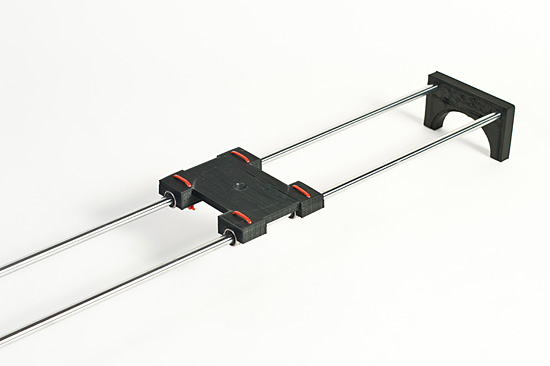
Here’s what the final piece looks like. One of the issues I had with the design Marcus created was that the rods only went part way into the plastic. There were screw holes to tighten down some screws onto the rods to hold things in place, but I never put any in. They might have also helped with the twisting issue this design has, but I may explore the idea of a two-piece design that clamps tight with the plastic. Or not… the nice thing is, it’s easy to experiment.

If I wanted to, I could probably make these ends out of wood, which would require just a drill press, or maybe out of a nice heavy metal, which might require drilling, or maybe milling. Both processes are a little messy, potentially more expensive, and require equipment you might not have. The nice thing about 3D printing these is that I can iterate a design quickly, and at a very low cost. I can even make them mostly hollow to save on time and materials during testing, and then make stronger, more solid versions when desired.

Nw Slider End

You may notice the carriage has some zip ties on it. Those are holding the LM8UU linear bearings in place. My original carriage was way too stiff, and without exact alignment (which you may not get with DIY plastic parts) it didn’t slide without some binding. The bearings were 58 cents each (I got a 10-pack from an ebay seller.) The bearings are a little noisy, so if you plan to shoot video with sound, you might have some issues. (Maybe more expensive bearing would make less noise?) As for the rods, they were about $15 each (pricey compared to the other parts) from VXB.com. There are cheaper alternatives depending on length, size, quality, etc. I went with 8mm because those are standard RepRap sizes.

At some point I may play with carriage designs as well. I actually did an early version that used felt instead of linear bearings (another trick from the RepRap world) which makes things cheaper and quieter, which may be desirable in some cases. And of course, I need to revisit the whole “motorized” part of this thing.

Until next time!

Categories
Uncategorized

Happy Hannukah

Dreidel

Happy Hannukah, everyone! Here’s the dreidel I made. It’s not made out of clay, or even “brey” (which is lead) but it is made out of ABS plastic. You know, the same plastic that LEGO are made of. You can make your own, just grab the file from Thingiverse and print it on your home 3D printer. Don’t have a 3D printer at home? You could always swing by Milwaukee Makerspace, or maybe the next MKE3DP Meetup.

Dreidel

If you’re wondering why the top of the dreidel is a funky black while the rest is white, it’s due to switching filament colors from black to white before printing, but not bothering to clear out all the black. I do this on purpose sometimes, because it causes this interesting effect.

Also, if the handle looks weird, it’s because I broke it and then re-attached it with acetone, but did it upside down. It still turned out very nice, in my opinion!

Categories
Uncategorized

Snowflakey

Tennis Man

Here’s a thing I’m calling (for lack of a better name) “Snowflakey”. The idea came from the Kimotion Arts store on Shapeways.

Kimotion Arts

Kimotion Arts has these neat 3D printed ornaments with an object arranged in a circle to make a snowflake-like thing. I dig it, so I decided to dig into it.

Bad Man

The first thing I did was fire up Inkscape and draw a really simple figure. It’s terrible, really, but I did it in less time than it took Inkscape to launch on Mac OS X. I created an SVG file, and then exported it as a DXF file, making sure I converted all the line segments into straight lines first. (Of course there were no curves in this drawing, but if there were, I’d convert them!)

Bad Man Flake

Once I had my DXF file, it was easy to pull that into OpenSCAD, and place six of them in a circle with the following code.


objheight = 4;
objcenterspacing = 20;
objrotate = -70;

for (i = [0:5]) {
  rotate(i*360/6, [0,0,1])
    translate([0, objcenterspacing, 0])
      rotate([0, 0, objrotate]) 
        linear_extrude(height = objheight, center = true) 
          import( "figure.dxf" );
}

The code is not the greatest… in fact there is probably much room for improvement, but it’s the first thing I got working, so I ran with it. My idea for the 3 variables at the top were so you could easily tweak them for different art. Sadly, as you change objcenterspacing and objrotate, they affect each other, so it’s a lot of back and forth between those two values. I also could not find a way to assign a filename to a variable, so your DXF will need to be named “figure.dxf” or you’ll need to edit the import line.

Tennis Man

Since my drawing was so terrible I wanted to try something else, so what better than Land recreation symbols 27, better known as “Tennis Man” by most people.

Tennis Man Flake

A few quick edits and I had this nice Tennis Man Snowflake for that special ball smasher on your list… (Notice the canvas size of 25mm wide by 35mm high. You can do what you want, but the OpenSCAD code will be expecting something close to that. Otherwise you’ll just have to tweak the numbers even more.)

Blobby Man Flake

I decided to try once again to draw something. This one took a little longer than a minute, but turned out just as terrible as the first one I did. Still, maybe you like “Blobby Man” as a snowflake.

Ant Flake

How about ants? This one is interesting. Maybe spiders would have been a better choice. (And yes, I know I could probably do the entire “6 items rotated” thing right in Inkscape, but that wasn’t the goal here.)

Horse Flake

What about the old nag? No, I’m not taking about your mother-in-law (kidding!) but this fine old horse from OpenClipArt.org, where I get many of the SVG files I use. Export this as an STL file and you’re ready to print it on your RepRap!

If you’ve got an improvement to this OpenSCAD code, by all means, let me know. I’m still very much in the learning phase with OpenSCAD, so I do these things to learn, and because of that I’m open to any suggestions.

Categories
Uncategorized

I heard you like cameras…

GoPro Mount

Yo dawg, I heard you like cameras, so I put a camera on your camera so you can take pictures of taking pictures…

Occasionally 3D printing is accused of being useless, or worse, silly. Well this is anything but silly, and it’s certainly not useless.

GoPro Mount

By combining the hot shoe mount I recently printed along with this Female GoProHD Mount we’ve got the camera-on-a-camera thing down like nobody’s business.

GoPro Mount

So yeah, camera on camera action, courtesy of 3D printing. Yeehaw.

But seriously folks, one of the great things about open 3D printing is that combos and mashups are quite common, and since we’ve first jammed a piece of chocolate into a hunk of peanut butter, sometimes things just go better together.

Categories
Uncategorized

Hot Shoe Mount

Hot Shoe Mount

In June I posted about my Hot Shoe Audio Mount which allowed me to put my Zoom H2 audio recorder on top of my DSLR… and I also had this to say:

The nice thing about the “Nikon DIY GPS Holder” I printed was that I can see it being a generic part I can modify in the future. I can easily import the STL file into Google Sketchup and built on top of it

Hot Shoe Mount

Well, in the past few months I’ve done a lot more in OpenSCAD than in Sketchup, so I wanted an OpenSCAD version of this thing, so while you can still grab the original Nikon DIY GPS Holder, there’s a new derivative, the Hot Shoe Mount, which features the OpenSCAD code.

Brain Slug

But what can do you with this OpenSCAD stuff? How about combining it with other OpenSCAD scripts so you can mount a Brain Slug on your camera? ;)