Categories
Uncategorized

Craft Hammers

Craft Hammer

I made a few Baltic Birch hammers (laser etched and laser cut) as a follow-up to my CRAFT Screwdriver (which was just vinyl cut.)

Craft Hammer

Here’s the design and mock-up. I use Inkscape for the design process, and occasionally create the mock-up images using Photoshop.

Craft Hammer

This hammer is not the size of a normal hammer. It’s over 400mm long, which (being nearly 16 inches) is big. Why such a big hammer? Because, reasons…

Craft Hammer

Actually, this specific hammer was given to Frankie Flood, who has had a huge influence on my work the past few years. Since he’s leaving Milwaukee, I wanted to give him something that would be suitable for hanging on the wall in his new studio.

Craft Hammer

HAMMERS!!!

Categories
Uncategorized

Teensy LC BOB v1.3

Teensy LC BOB v1.3

Update: If you’d like one of these boards, there’s a newer version of this board, and you can purchase it on Tindie.

Good News, Everyone! The new Teensy LC break-out board is ready! Yes, we’re now at version 1.3 of the Teensy LC BOB.

Preview

I’ve made a few changes since version 1.2. I moved the traces from the top to the bottom (how did I miss that!?) and I added an extra ground line so that you can connect a bunch of screw terminals to the ground row even if you don’t solder in header pins at the end of the board and only do the sides. (This also comes in handy if using the Teensy Audio Adaptor Board.)

I’ve also lengthened the board a bit, and added a fifth hole, and here’s why…

Installed

For a recent project I discovered that the USB cable was able to rip the USB connector right off the Teensy if hit, twisted, or yanked in the wrong direction. The fifth hole is for adding a piece (wood? plastic?) by screwing it into the bottom and then looping a zip tie around the USB cable for strain relief.

USB mock-up

I scanned in a Micro USB cable and placed it over an image of the board to figure out spacing. It should work. I may end up 3D modeling the piece that holds the USB cable in place.

As I use the boards more I may find other improvements along the way. Also, I’m now able to load in custom images and graphics onto the PCB, so I’m already scheming for my next OSH Park project.

Categories
Uncategorized

Arts+Tech Night at UWM

Arts+Tech Night

I mentioned back in February that I’ve been teaching a Physical Computing class at UWM called “Electronics and Sculpture” this semester. So I’ve basically been showing students how to integrate microcontrollers into their artwork. (Arduino is the order of the day, though I’ve got one student exploring ATtiny85 chips.)

Students have been working on their final projects, using techniques they’ve learned all semester, and they’ll have their work on display for the public at Arts+Tech Night happening 6pm-9pm, Wednesday, May 18th, 2016. Come on down and check it out. Most of my students will be on the 4th floor in the center area. (Maybe your friends are already going!)

mike-light

(There is a web site for ATN but sadly, despite my best efforts, It has not been updated this time around.)

Categories
Uncategorized

Learn to Solder Kit (Part IV)

This installment of the Learn to Solder Kit series will focus on the cutting and sanding of the PCBs we’ve been creating. This is the loud and messy part. (Check out Part I, Part II, and Part III if you haven’t seen them.)

pcb-cut-sand-0316

We start with taking one of the larger board to the bandsaw and cutting apart the six boards. (The bandsaw, like many of my tools, belonged to my father. It’s quickly become one of the most used tools in the shop, right after the drill press.)

pcb-cut-sand-0318

In an earlier revision of the board I left very little room to cut things apart. I just barely had the width of the saw blade, so as I etched more boards, I revised the design and increased the space to make things a bit easier.

pcb-cut-sand-0324

One large board cut down to six individual boards. I also cut off any excess on the edges to make the sanding process that comes later easier.

pcb-cut-sand-0329

You can see that straight lines aren’t the order of the day, which is fine. Our goal with the cutting apart is just to get things cut apart. We’ll straighten out the edges later…

pcb-cut-sand-0328

Here’s a big pile of individual boards ready to have their edges cleaned up. You’ll noticed the thin edge pieces that got cut off as well, which saves us time (and dust!) when sanding.

pcb-cut-sand-0337

Using the disc sander is pretty quick, but it’s also dusty, and probably my least favorite part of the process. Also, the disc sander is a cheap model someone gave me, and while I’m thankful for it, it’s loud and vibrates way more than it should.

pcb-cut-sand-0340

Cleaned up edges, courtesy of the disc sander. We’ve finally got those straight lines we didn’t get on the bandsaw.

pcb-cut-sand-0341

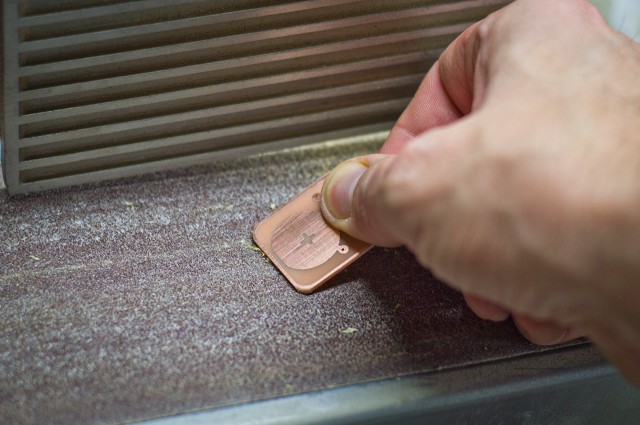
Once we have those nice clean sides on the board it’s time to round the corners. This is the part that requires a some finesse to make it nice. Sometimes I get great results, and sometimes I go quickly and say “good enough!” because I’ve got 20 more boards to do.

Oh, you might also notice a bit of “fuzz” on the edges…

pcb-cut-sand-0347

Here’s the back side of the board, where you can more clearly see the fuzz left from the sanding process. This is easy to clean up.

pcb-cut-sand-0350

We just lightly clean the fuzz off using the belt portion of the sander. Every now and then I drop a board while doing this and have to fish it out of the exhaust port. It’s annoying.

pcb-cut-sand-0355

Here’s our nice clean board. It’s been cut apart from the larger board, and then sanded to get straight edges, given rounded corners, and cleaned up of any fuzz. Ready to go!

pcb-cut-sand-0360

A big pile of finished boards at the end of the night. I can only take so much sanding in one session. Right now I’ve got 40 completed boards, and another 25 that need to be sanded. With a goal of 100 total I’ll need to etch, drill, cut, and sand about 6 more large boards (to get 36 individual PCBs) in the next two weeks in time for the Maker Plaza at the Zoom Milwaukee Symposium!

This is just one post in a series, check out the other posts as well:

Categories
Uncategorized

Learn to Solder Kit (Part III)

If you’ve been following along as I develop a Learn to Solder Kit (see Part I and Part II) you’ll know that after etching the boards, we’ll need to add holes for all of the through-hole components that will be soldered into place.

dremel-drill-press

I’ve been using a Dremel Drill Press we have in the Physical Computing Lab at UWM to drill all the holes. The bits are tiny, at 1mm or less in diameter. I’ve broken two already, so I’ve got a bunch more on order to replace the broken ones. The first one I broke right when I started drilling boards, probably because I was trying to drill a bit too fast. It’s important to remember that the bit needs to do the work of cutting. The tiny tools don’t work quite like the big tools you can be rough with. The second bit I broke was due to moving too fast, basically I’d drilled a ton of boards and was getting near the end and just didn’t take my time when moving the board, and slid it a bit before I fully lifted the bit out of it. Oh well…
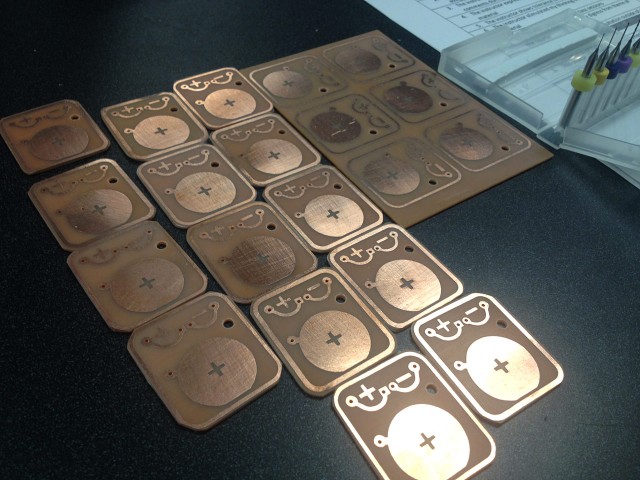
drilled-boards

Here’s a collection of drilled boards. Some are cut apart, and some are not yet cut apart. (We’ll cover the “cutting” part in a future installment.)

drill-wire-hole

You’ll notice there’s one hole that is much larger than the rest. That hole is for a wire to feed through, and I drill that hole with my big drill press. The large copper pad you see is just used as a guide, and gets obliterated by the drill.

Drilling the large holes is a quick and easy operation compared to the smaller holes for the components. You’ll notice that this drilling leaves a bit of “crap” around the hole after the drill bit is lifted out of the material, so we’re going to clean that up…

cleaning-bit

Using a much larger bit (and our hands instead of the drill press) we just lightly twist the bit around a few times in a clockwise direction. This is enough to let the bit shave away the excess material. It helps to have sharp drill bits when doing this. This too is a quick operation, with just a few twists for each hole, on the front as well as the back. Clean holes are good holes!

clean-hole

Here’s the difference between a cleaned up hole (left side) and a bunch of non-cleaned up holes. It is an extra step to clean things up, but when you make things (and you care) it’s just something worth taking the time to do…

Now, as I’ve mentioned, I’ve been using the Dremel Drill Press at UWM for the component holes, and while it works fine, the semester is over, so I won’t be there twice a week, so I’ve been thinking about other solutions for drilling all the holes.

old-dremel

I could buy a Dremel Drill Press for $35 and have our friends at Amazon deliver it in two days, but there’s a few issues with that, the first of which is, my Dremel tool is old, like really old, like 25 years old maybe? Perhaps more? It belonged to my dad, and maybe even his dad. It’s old, but it works great, and I’m not planning to replace it… and sadly, I don’t think it fits the modern Dremel Drill Press, at least not without modifications.

I’ve also heard from my pals over at Evil Mad Scientist Laboratories that the Dremel Drill Press lacks precision for some jobs. They like the Vanda-Lay Industries Drill Press Plus, which looks pretty solid. It’s not cheap though. There’s also the DIY press Bryan Cera made. I could certainly go the DIY route, and there’s a few other options on Thingiverse to choose from.

Right now though, I probably shouldn’t be spending time trying to DIY up my own solution to a miniature drill press since I can head over to Milwaukee Makerspace and use what we have there. I know we’ve got a “ProtoDrill” thing that drills out boards. It drills from the bottom, and has a foot switch to control it. It didn’t work amazing last year when I tried it, but I’m guessing there’s a few tips to using it I wasn’t aware of. There’s also a bunch of newer Dremel tools and a mini press at the space. The fine folks at Dremel were kind enough to donate some nice tools to us after Maker Faire Milwaukee in 2014.

generic-presses

For my immediate needs, I can drill holes at a variety of makery places around Milwaukee, so I’m not too concerned about a solution for my home shop. I have seen a few generic “rotary tool” drill press stands, which might be easily adaptable to work with my old Dremel tool. If I don’t go the DIY route, I may just grab one of those.

Update: I built my own.

This is just one post in a series, check out the other posts as well: